 |
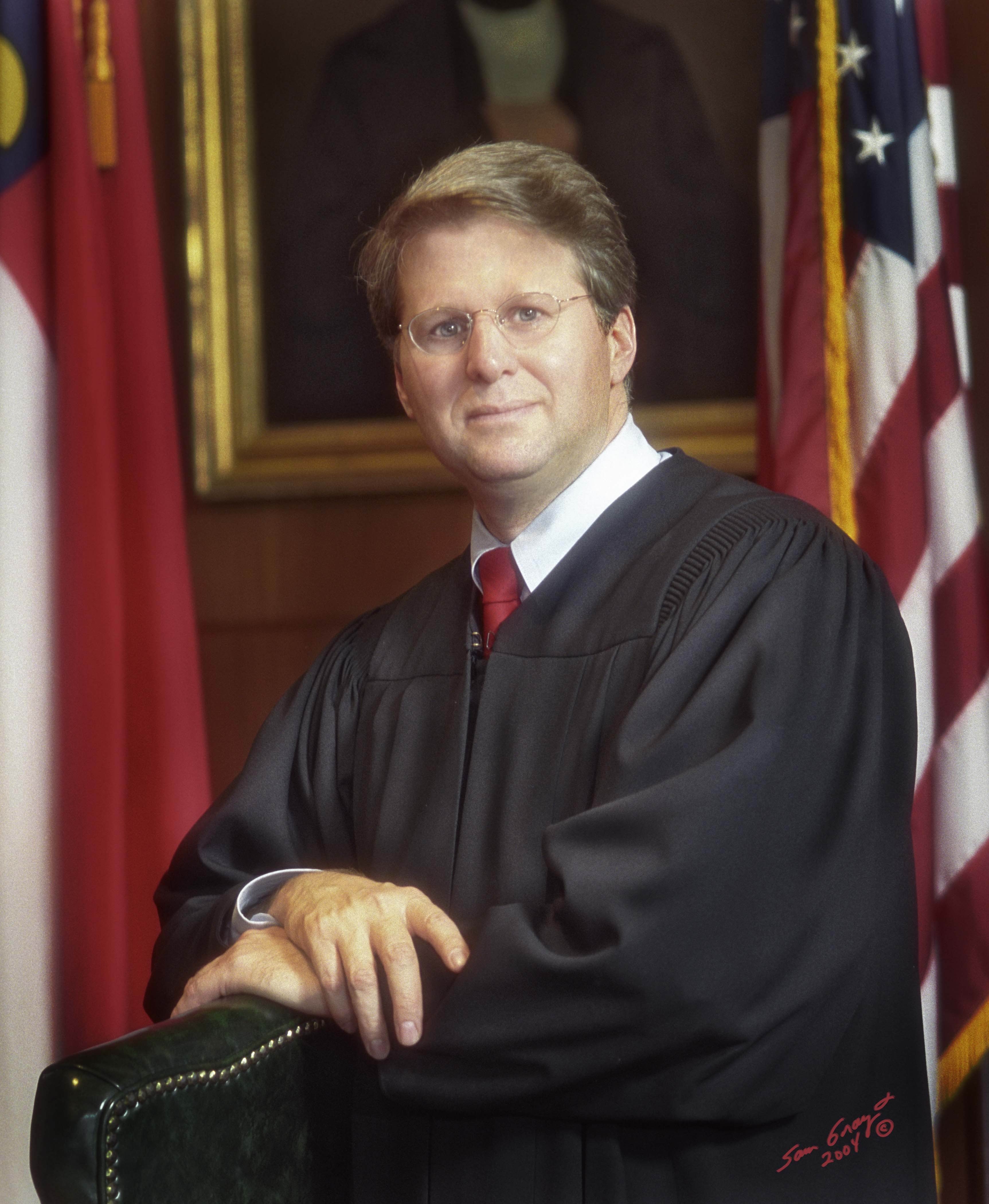
Justice Mark MartinNC Supreme Court Chief Justicewww.martinforchiefjustice.comJudicial CQQ Score: 75%There are no challengers in this race |
Bio:
Mark Martin is the Senior Associate Justice of the Supreme Court. With over twenty years of judicial service, Justice Martin is the only active member of the North Carolina state judiciary with experience on the Supreme Court, Court of Appeals, and Superior Court.
Prior to his judicial service, Martin served as legal counsel to Governor James G. Martin (no relation), practiced law at the McNair Law Firm in Raleigh, and clerked for United States District Judge Clyde H. Hamilton. Martin has served in a number of leadership roles within the North Carolina Bar Association, including as its Vice-President. He has taught law courses at the University of North Carolina, Duke University, and North Carolina Central University. Martin graduated summa cum laude from Western Carolina University. He received his Juris Doctor, with honors, from the University of North Carolina School of Law. He later earned a Master of Laws (LL.M.) in Judicial Process from the University of Virginia.
Mark is married to Kym Martin. Five bright kids call him dad.
To Listen To His Interview please click HERE

Showing 18 reactions
Sign in with
Thank you.
Justice Martin has, on at least two occasions, legislated from the bench by concurring with NC Supreme Court decisions that are clearly unconstitutional. Summaries are provided below for your review, however, I encourage readers to spend more time researching these (and other) cases to arrive at their own conclusions.
State v. Heiden (Fourth Amendment Issue)
Justice Martin joined the majority opinion in significantly weakening the Fourth Amendment’s protection against unreasonable searches & seizures. This 2012 decision allows the police to violate your Fourth Amendment rights as long as they reasonably believe that you broke the law, even if you didn’t. Ignorance of the law is now a defense available to the police, but not to the average citizen. This decision has essentially created two classes of citizens in North Carolina, with unequal protection under the law. Rather than being held to a higher standard, law enforcement is now held to a lower standard than the common citizen.
From the Majority Opinion:
“Indeed, because we are particularly concerned for maintaining safe roadways, we do not want to discourage our police officers from conducting stops for perceived traffic violations.”
Re-read the above statement. This is a crystal clear case of legislating from the bench.
An officer’s mistake in law cannot be the basis for a reasonable suspicion of a crime.
From the Dissenting Opinion:
“The flaws in the majority’s opinion are perhaps most apparent in its single statement that ‘police officers should be entitled to interpret our motor vehicle laws reasonably when conducting routine traffic stops’. Separation of powers doctrine dictates otherwise: It is the legislature’s job to write the law and the judiciary’s job to interpret the law. The job of the police is to enforce the law at it has been written by the legislature and interpreted by the courts. Proper enforcement of the law requires accurate knowledge of the law; as the 11th Circuit cogently noted in United States v. Chanthasouxat, to decide otherwise is to endorse ‘the fundamental unfairness of holding citizens to the traditional rule that ignorance of the law is no excuse while allowing those entrusted to enforce the law to be ignorant of it.’”
State v. Ortiz-Zape (Sixth Amendment Issue)
Justice Martin joined the majority opinion in a case involving the Sixth Amendment’s Confrontation Clause. The Confrontation Clause is commonly known as the right to confront your accuser in court, and the exclusion of hearsay (i.e. “Johnny told me he saw Billy commit the crime.”). The majority opinion essentially said that the Confrontation Clause does not apply when to expert witness testimony relating to scientific testing. So, “I reviewed Johnny’s test results that say Billy committed the crime,” is now somehow alright according to the majority opinion.
From the Majority Opinion:
“The admission of an independent expert opinion based on the expert’s own scientific analysis is not the type of evil the Confrontation Clause was designed to prevent.”
If scientific analysis is the only evidence that is relevant to the case (i.e. without it there is no evidence to convict), then how can this be viewed differently than the “evil” of hearsay eyewitness testimony?
From the Dissenting Opinion:
“Because the expert here (Agent Ray) simply viewed and agreed with the test results of another (Agent Mills), while she performed no testing and was not present for those tests, I must conclude her testimony violates the Confrontation Clause.”
The majority opinion flies in the face of the United States Supreme Court ruling in Crawford v. Washington (2004) which upheld and affirmed the intent of the Sixth Amendment. The Court said, “Dispensing with confrontation because testimony is obviously reliable is akin to dispensing with jury trial because the defendant is obviously guilty.”
This case was decided 9-0, with Justice Scalia writing the majority opinion.
Based on these two cases alone (and I have not reviewed any other cases where Justice Martin presided), I cannot conclude that he is a strict follower of the letter and intent of the United States Constitution. His actions speak louder than his words. I would urge my fellow iCaucus participants to vote against the endorsement of Mark Martin for Chief Justice of the North Carolina Supreme Court.